
1. Understanding When Overhead Power Lines Matter
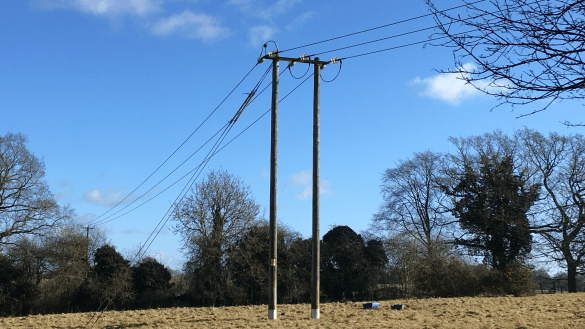
Overhead power lines are often easy to overlook—many appear thin, lightweight or similar to telephone or broadband cables. But if they cross your driveway, boundary, roofline or garden, they can pose a serious safety risk during exterior cleaning.
What to look for:
- Wires suspended above your garden, driveway or roof.
- Poles supporting bare or semi-insulated electrical conductors (not telecoms).
- Lines crossing the areas where our ladders, poles, access platforms or boom lifts must operate.
Why this matters:
Even low-voltage lines can cause fatal electric shock. Close approach alone—not just physical contact—can be enough to create a dangerous electrical arc.
When we raise a safety flag:
- If any equipment needs to work within several metres of the wires.
- If the lines run over access routes our MEWP (mobile elevated work platform) must pass under.
- If wires cross the work area for your gutters, windows, roofs or high-reach surfaces.
2. Why Working Around Power Lines Is Dangerous
Cleaning equipment such as ladders, telescopic poles and boom lifts introduces a heightened safety challenge around overhead lines. Even a small movement in the wrong direction could unintentionally enter a danger zone.
Key hazards include:
- Direct contact – Any tool, ladder or platform touching a live wire can be fatal.
- Flashover/arcing – Electricity can “jump” across a gap, especially with higher voltages.
- Uncontrolled movement – Lifting and rotating equipment can drift into unsafe proximity.
- Assuming the power is off – Unless the electrical network operator formally isolates the line, it must always be treated as live.
Because exterior cleaning involves working at height, our team must account for these risks with precise planning and professional control measures.
3. Safe Distances: What We Must Maintain
Professional cleaning around power lines is guided by strict separation distances.
General rules include:
- Work planned within 10 metres horizontally of overhead lines requires specialist advice or approval from the line owner.
- Additional separation may be required for machinery working underneath wires.
- Exclusion zones, barriers or dedicated safe routes may be needed.
What this means for your property:
Before any roof cleaning, gutter clearing or boom-lift access, we measure and map the distance to every overhead line. If our equipment could operate within the 10-metre advisory zone, we speak to the Distribution Network Operator (DNO) and arrange extra precautions—or request isolation if required.
4. Who Checks the Lines Are Safe – And What We Do for You
Every overhead line belongs to your local Distribution Network Operator (DNO). They can confirm:
- The voltage
- Safe working distances
- Whether isolation is needed
- Whether they must attend site
- Any associated costs
What we do as your cleaning specialists:
- Identify and record all overhead lines during our survey
- Advise you on the safest method to complete the job
- Contact or assist with contacting the DNO
- Plan the correct equipment, access route and working method
- Provide written documentation and job-specific safety controls
You can relax knowing we handle everything professionally and transparently.
5. How We Work Safely Around Overhead Power Lines
Depending on the circumstances, control measures may include:
Avoidance
Where possible, we adjust the method to avoid the wires completely—for example, accessing from another angle or working on unaffected sections first.
Line isolation or diversion
If the safest option is to have the line temporarily turned off or rerouted, we help organise this with the DNO.
Clear exclusion zones
Barriers, cones, signage and designated machine routes reduce risk and keep the team and property completely safe.
Competent operators and compliant equipment
Only trained, qualified professionals operate our MEWP, ladders and high-reach systems.
Method statements, risk assessments and supervision
For more complex properties, we prepare full documentation and oversee the work with an appointed supervisor.
For homeowners and property managers:
Simply let us know if you’re aware of any overhead wires, and we’ll do the rest. If isolation is needed, we’ll guide you through the process before work begins.
6. Why Choosing a Professional Team Matters
High-value properties demand careful, professional service—especially when electrical hazards are present. Working with a specialist exterior cleaning company like ours ensures:
- Safe access planning and site-specific assessments
- Professional equipment operated by qualified staff
- Insurance-backed work carried out to HSE standards
- Full documentation, training certificates and method statements
- Premium results delivered without compromise
We’re not the cheapest—but we are the safest and most thorough. That’s Trust in the Detail.
7. Summary and What to Do Next
If you’ve noticed overhead wires near the areas we need to clean—rooflines, gutters, driveways or access routes—don’t worry. It simply means we’ll take additional steps to ensure the job is completed safely and to the highest standard.
We will:
- Survey the property
- Identify all overhead lines
- Determine the required safety distance
- Liaise with your DNO if needed
- Implement any isolation, diversion or exclusion zones
- Complete the work professionally, safely and efficiently
Book a free survey
If you’d like us to visit your property to assess overhead power lines and plan your cleaning safely, just let us know a convenient time. We’ll handle everything from there.